

My Market View
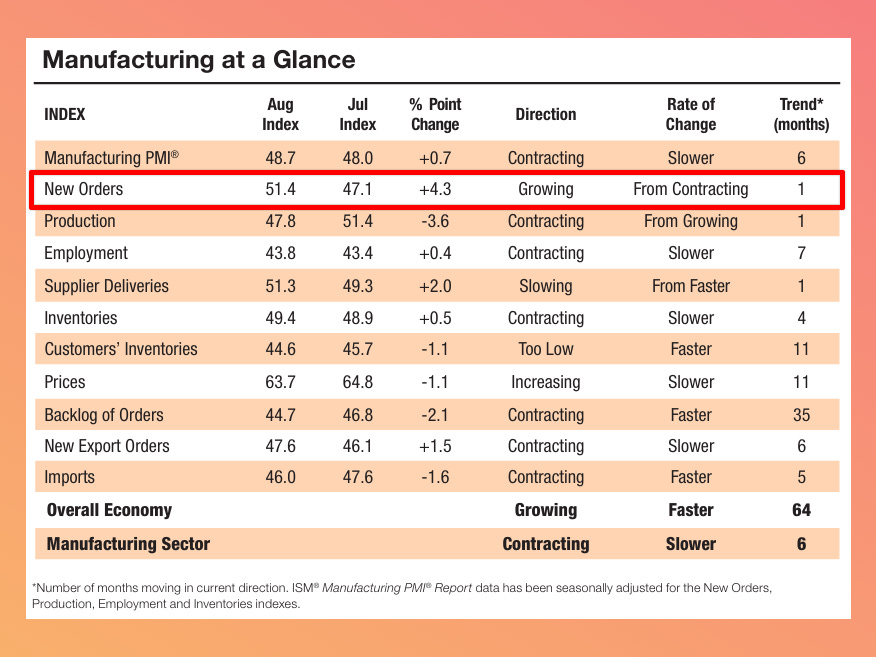
September began with weak ISM Manufacturing PMI data for August. At this point, such weakness feels almost routine - it’s been happening for months.
One detail I paid close attention to: New Orders flipped from contracting to growing. That’s a positive sign but one month of improvement isn’t enough to establish a trend. It could just as easily flip back. For now, nothing fundamentally new for the markets.
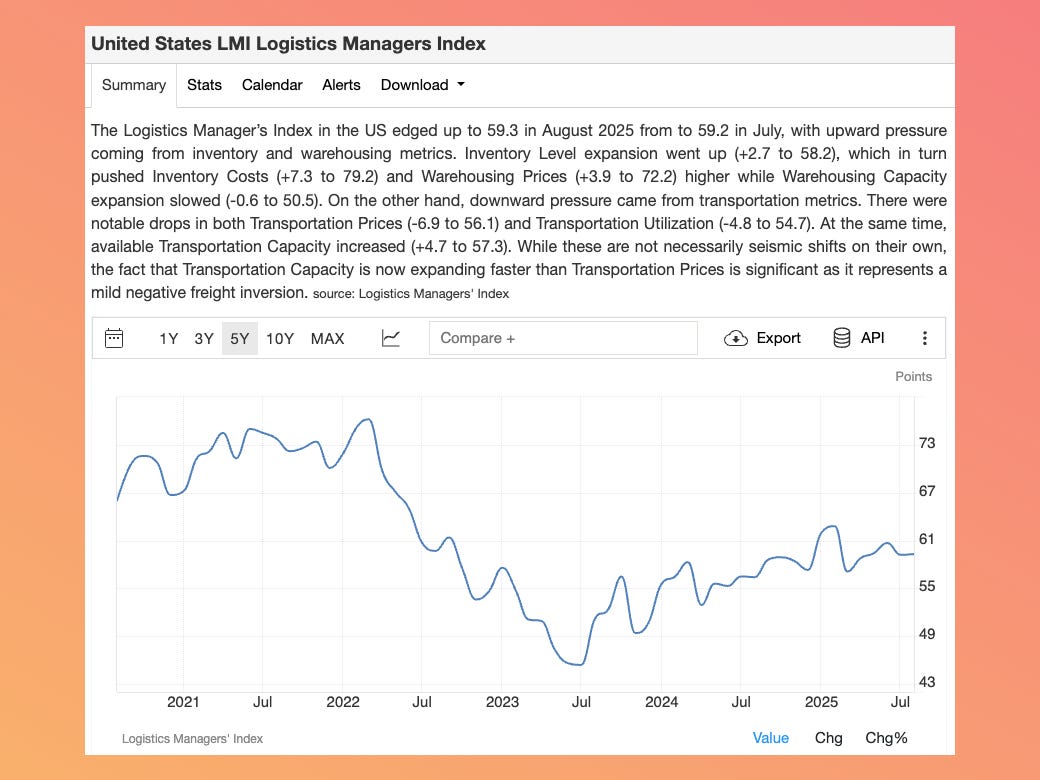
This data pairs well with the Logistics Manager’s Index released the same day. Companies built up solid inventories in August and weren’t in a hurry to replenish them.
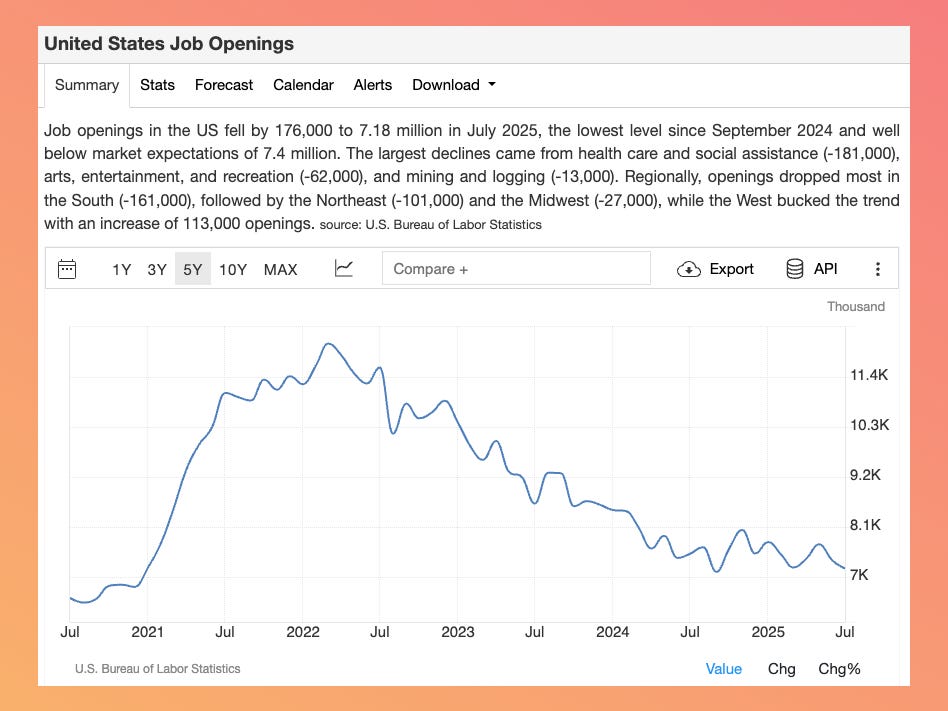
Meanwhile, job openings confirm a cooling labor market.
I expect more volatility once we get fresh data on business and consumer health - the ISM Services PMI and employment data due tomorrow and Friday will be key.
My L/S Stock Options Portfolio Positioning
I’m working to keep my long/short options book aligned with potential outcomes the financial markets could face this quarter.
Scenarios I’m watching:
Rotation.
From AI hardware-driven industries toward software (previously pressured by AI replication risks) and defensive sectors like Consumer Staples and Healthcare. In this case, the broad market could be slightly lower or flat in September, then push higher into year-end. That keeps us within a bull market framework.
Fear of recession.
If labor market deterioration accelerates and rate cuts fail to stabilize conditions, consumer discretionary spending will stay weak. This could trigger a correction across most sectors.
Sticky inflation.
Inflation holding steady in its current range wouldn’t necessarily hurt markets - as long as corporate profits remain intact and consumers stay resilient.
Right now, I see a mix of scenarios 1 and 3 playing out, and I’m managing my portfolio accordingly.
👉 In this issue:
Full long/short options portfolio (tickers, position sizes, expiries)
Detailed reasoning behind each trade
The sectors I see as the next volatility catalysts
📊 YTD, this strategy is up +102.5% on capital - and these are the actual trades driving that performance.
Portfolio Constituents
It’s crucial to treat the stock market as a structured system of sectors and industries when building a portfolio or generating ideas.
Longs (Call Structures)
Defensive positions: CL 0.00%↑, TMUS 0.00%↑
Growth stocks: CELH 0.00%↑, AAPL 0.00%↑, CVLT 0.00%↑, DUOL 0.00%↑
International growth stocks: FTI 0.00%↑, BIRK 0.00%↑
Tail risk trade: KYIV 0.00%↑
Shorts (Put Structures)
AI hardware devaluation: CAT 0.00%↑, MOD 0.00%↑
Overhyped growth stock: IONQ 0.00%↑
Weak consumer-driven story: CMG 0.00%↑, BBY 0.00%↑
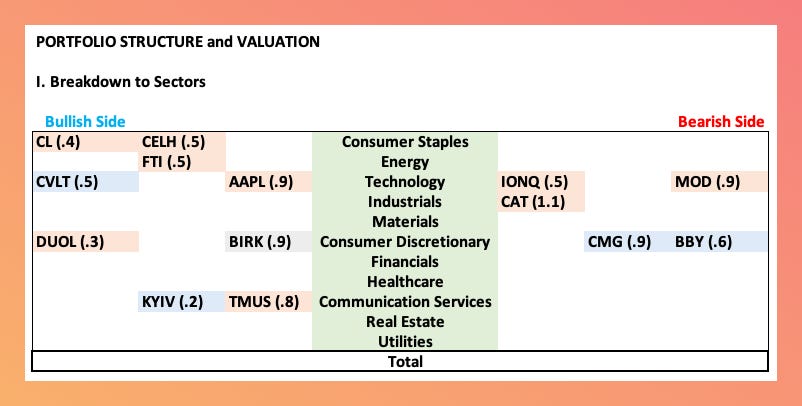
👉 Cell colors distinguish the month of the option contract expiration from November to January next year.
👉 Numbers in brackets = portion of a full-size position, depending on conviction.
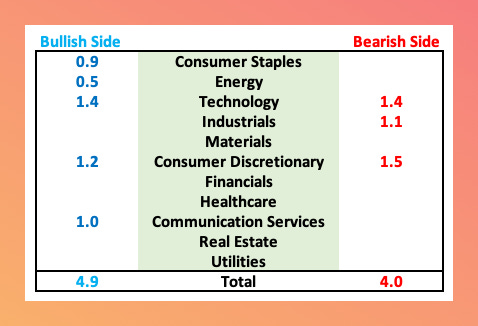
👉 My cap is 12 full positions; currently I hold 4.9 longs vs. 4 shorts. Positioning is tuned as new data and ideas emerge.
This morning, I closed a long trade on ZS 0.00%↑ after earnings came in just “normal.” The company is fundamentally strong, but volatility wasn’t sufficient for an options play. Revenue growth guidance (~22% YoY) versus EPS growth (~13% YoY) signals margin pressure and scaling challenges. Add recent merger costs, high R&D spend, and rising debt costs - and the market’s skepticism is justified. In the current market, you need to be extremely picky in the stock selection process.
I’ll spend the next few days researching before restructuring positions or adding new ideas as more data comes in.
Piece of Knowledge
The stock market is best understood as a strict structure of sectors and industries.
There are two main classification systems:
GICS (Global Industry Classification Standard) → the standard for the investment world.
NAICS (North American Industry Classification System) → the official U.S. system, often more precise for detailed comparisons.
For general market structure, it’s essential to memorize GICS sectors and industries. Beyond that, I recommend keeping a reference file with sub-industries for deeper analysis.