

Market View
Fears about elevated inflation evaporated with the latest data prints.
That suggests last month’s PPI spike was more of a one-time event than the start of a new trend.
Tariffs also didn’t affect the inflation data, for a few possible reasons:
Companies may want to pass higher import tariffs on to consumers, but demand isn’t strong enough to absorb those price hikes.
Many goods sold now were imported earlier at lower prices, so the newer, higher-priced shipments haven’t yet hit the shelves.
Since goods make up only about 30–35% of consumer spending (PCE) and services account for 65–70%, tariff hikes on goods mainly raise goods prices first. But because goods are a smaller share, the immediate effect on overall inflation is limited.
I see “animal spirits” are returning to the market, and we may see bulls pulling stocks higher through year-end.
Of course, nothing is guaranteed in markets, and all eyes now turn to the reaction to Retail Sales and the Fed’s Economic Projections data next week.
Corporate Earnings
Alongside the macro picture, let’s take a look at corporate earnings.
The overall revisions trend remains positive, with estimates for the back half of the year steadily moving higher.
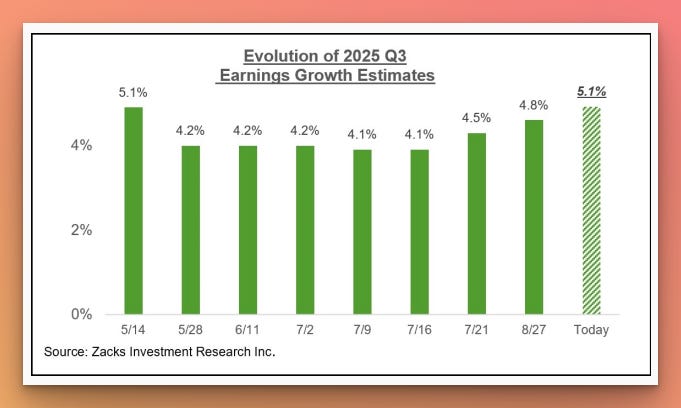
That’s constructive for Q3 earnings season, but it also raises the risk that actual results could fall short. Put differently, expectations may now be running ahead of reality.
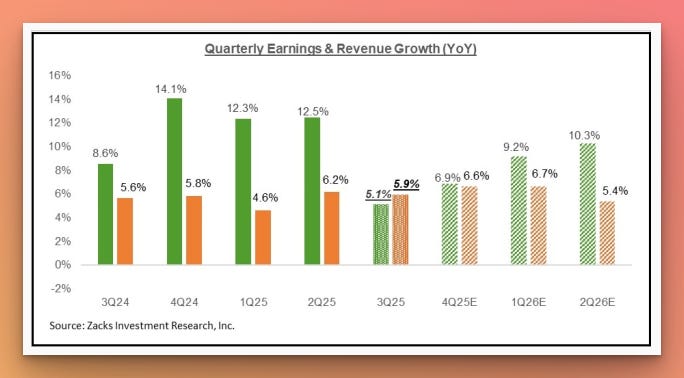
The chart below shows Q3 2025 expectations in the context of results from the prior four quarters and what’s currently projected for the next three.
👉 In this issue:
Portfolio Update: how my portfolio shifted this week
Decision Process: detailed reasoning behind each trade
Piece of Knowledge: 3-step options structuring process I use
📊 YTD, this strategy is up +102.5% on capital - and these are the actual trades driving that performance.
Portfolio Update
I’ve tilted my portfolio more bullish, adding exposure to cyclical and tech names.
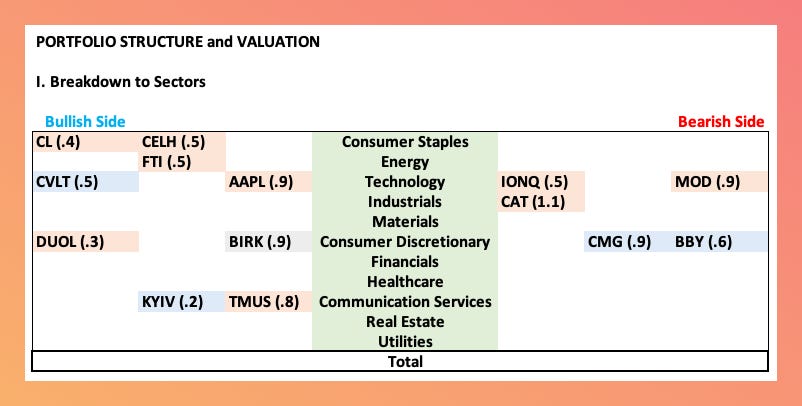
Last week my book looked like this:
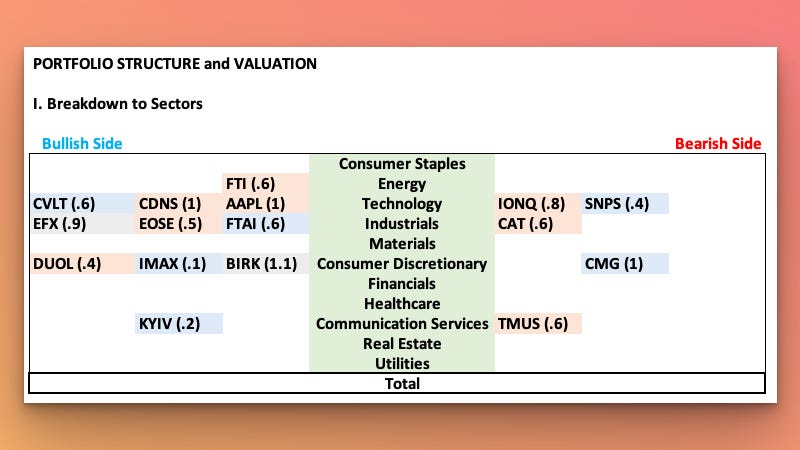
Now it looks like this:
With recent economic data broadly in line with consensus, the market seems to be leaning into the “all-mighty rate cuts” scenario - making it a good time to have cyclicals on your side.
I closed defensive positions in Colgate CL 0.00%↑ and T-Mobile TMUS 0.00%↑, while adding CDNS 0.00%↑ FTAI 0.00%↑ EFX 0.00%↑ and AI-related EOSE 0.00%↑.
Oracle’s huge rise in RPO gave fresh momentum to AI-related stories, and being short in that space would now mean trading against the wind.
That’s why I closed my short in Modine MOD 0.00%↑, and trimmed exposure to Caterpillar CAT 0.00%↑.
Instructions on how to read the images:
👉 Cell colors distinguish the month of the option contract expiration from November to January next year
👉 Numbers in brackets = portion of a full-size position, depending on conviction
👉 My cap is 10 full positions; currently I hold 7.1 longs vs. 3.6 shorts. Positioning is tuned as new data and ideas emerge.
How I make decisions
At some point, I’ll publish a full guide on how I pick stocks for this long/short options strategy. For now, here’s the reasoning behind the moves I made this week:
Colgate CL 0.00%↑ → This trade would have worked if inflation had meaningfully picked up. Consumer staples are resilient in inflationary environments and tend to rise. Since that didn’t play out, I had no reason to keep Colgate in my book.
T-Mobile TMUS 0.00%↑ → My favorite trade this week. Elon Musk’s SpaceX bought spectrum from EchoStar to launch its Direct-to-Cell Starlink service. This will challenge the Big 3 mobile operators - T-Mobile, Verizon, and AT&T - and could be a major disruption. I think Berkshire Hathaway’s decision to sell T-Mobile last quarter was based on the same outlook. At this point, I prefer being short.
Cadence Design CDNS 0.00%↑ / Synopsys SNPS 0.00%↑ (pair trade) → Synopsys disappointed with a weak report and slashed guidance. That was company-specific, so I went long Cadence Design (another industry leader) while shorting Synopsys.
FTAI Aviation FTAI 0.00%↑ → There’s a strong tailwind in aircraft spare parts and engines. Post-COVID, airlines still face fleet shortages and are extending the life of planes through heavy maintenance. FTAI Aviation is the #1 beneficiary of this trend.
Equifax EFX 0.00%↑ → A macro trade. With markets pricing in more rate cuts and the economy finding momentum, demand for identification services in areas like hiring, mortgages, and finance should strengthen.
Eos Energy EOSE 0.00%↑ → A pure AI-energy story. The company provides mobile energy solutions designed for remote suburban locations.
📌 Stock research is the foundation of my options trading process. I share quick research notes on X.
Piece of Knowledge
Today I’ll show you the options calculator I use for structuring trades. It’s a simple spreadsheet where I input key stock data and calculate the potential return if the stock price reaches my target.
The first step is entering the basic stock information. The crucial part here is setting the target price, since the entire option structure will be built around it. That’s a big topic on its own, and I’ll cover it in a separate post. For now, here’s an example with Apple AAPL 0.00%↑.

Once the target price is set, I choose the option structure that fits the potential move. I typically use bought calls/puts, calendars, or vertical spreads. In the example below, I used a calendar spread. (If you’d like more detail, check my free Options Trading Guide where I cover these structures step by step.)

The final step is calculating the potential return. My rule of thumb: I aim for a minimum 200% return on a single trade.

I’ll keep diving deeper into this topic over time - so stay tuned.
🙏 I really appreciate your support. If you liked this post, please tap ❤️